Distributing hundreds of customer visits across multiple technicians. Taking into account locations, travel times, available capacity and agreed time windows. And at the same time keeping mileage and operational costs down.
That is no ordinary planning task.
It is a complex calculation with millions of possible combinations. A human planner can never compare them all. FieldGenius does it in seconds.
But how good are those calculated routes really?
To measure that objectively, we tested FieldGenius v2.4.1, the current version of our platform, on 328 internationally used benchmark scenarios for route optimisation. We compared our results with the best known solutions and with figures from renowned optimisation technology such as Hexaly and Gurobi.
Our own product development, tested internationally
FieldGenius is our own product development. Our team builds and refines the optimisation core itself and keeps improving the platform, tuned to the daily reality of planners and field service teams.
Precisely because we develop that technology ourselves, we want to know objectively where we stand. No gut feeling, no demo effects: measured against international references.
How FieldGenius v2.4.1 scores at every scale
The benchmark scenarios range from 25 to 400 customer visits per planning round. For each scale we measure the average route-distance deviation from the best known solution. The lower, the better:
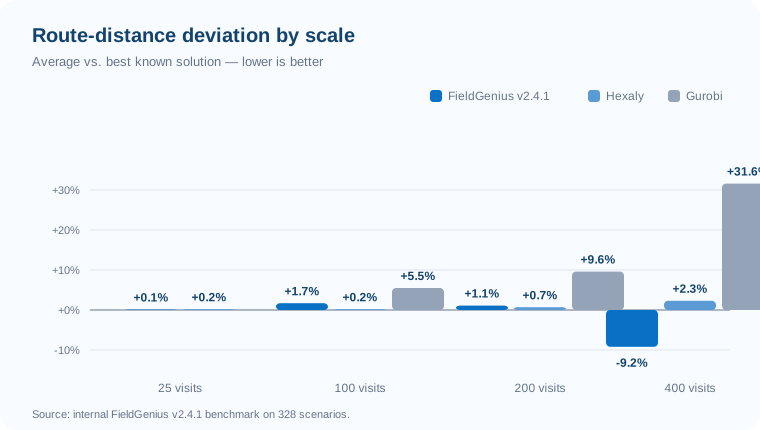
- 25 customer visits: FieldGenius +0.1%; Hexaly +0.2%
- 100 customer visits: FieldGenius +1.7%; Hexaly +0.2%; Gurobi +5.5%
- 200 customer visits: FieldGenius +1.1%; Hexaly +0.7%; Gurobi +9.6%
- 400 customer visits: FieldGenius -9.2%; Hexaly +2.3%; Gurobi +31.6%
For smaller schedules, FieldGenius results stay close to the best known solutions. But the most striking result appears in the largest scenarios.
The striking result at 400 customer visits
The larger the schedule, the heavier the computational task. Precisely there, in scenarios with 400 customer visits, spread across 60 different benchmark cases, FieldGenius v2.4.1 delivers its strongest performance.
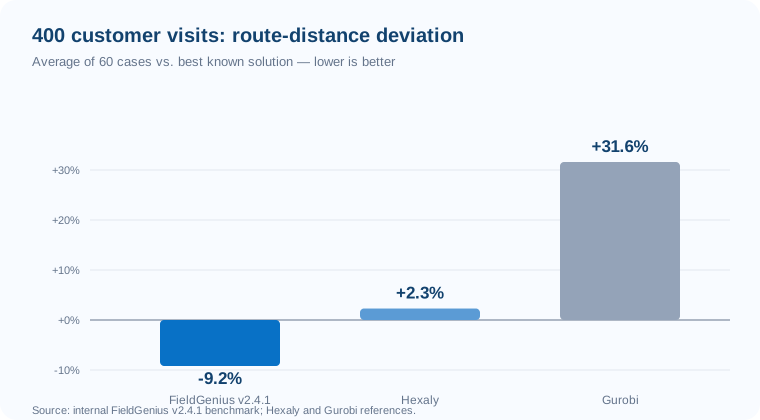
- FieldGenius v2.4.1: -9.2%
- Hexaly: +2.3%
- Gurobi: +31.6%
A negative deviation means that in these cases FieldGenius calculates shorter routes on average than the best known reference solution. That is a particularly strong performance.
And it is not only about distance. The system also scores well on the number of vehicles deployed (in practice: technicians or crews). In 35 of the 60 benchmark scenarios with 400 customer visits, FieldGenius uses the same number of vehicles or fewer than the best known solution. In the remaining 25 cases it uses at most three additional vehicles.
Conclusion: FieldGenius v2.4.1 achieves the best average route-distance result within this comparison at 400 customer visits. Moreover, in a majority of cases the system uses the same number of vehicles or fewer than the best known solution.
It shows that FieldGenius is not only competitive on smaller schedules. Even when complexity increases considerably, the system calculates routes that measure up to world-class technology.
What do those customer visits mean?
The numbers in the benchmark are not customers per day, week or month.
They indicate how many stops or jobs have to be processed within one planning round. Depending on the organisation, such a round can cover a working day, a shift or another planning period.
The vehicles from the benchmark translate in practice to technicians or crews that each get a route assigned.
In doing so, FieldGenius can take into account:
- the location of every job
- travel times between customers
- available technicians
- capacity and skills
- agreed time windows
- operational constraints
The system then looks for an efficient and feasible distribution of all jobs.
From technical performance to business result
A strong benchmark is nice. But for a company, what counts most is what the technology delivers in practice.
More efficient routes can lead to:
- fewer kilometres
- lower fuel and vehicle costs
- less time lost on the road
- more available time for customers
- more jobs with the same capacity
- more reliable service delivery
- less pressure on planners and technicians
One kilometre of difference may seem limited. Multiply it by several technicians, hundreds of jobs and every working day of the year, and the impact becomes considerable.
Route optimisation is therefore not a technical detail. It is a strategic lever for productivity, customer satisfaction and profitability.
The planner stays in control
FieldGenius does not replace the experience of a good planner. It strengthens it.
The system takes over the complex calculations and quickly proposes a well-founded schedule. The planner keeps the overview and can adjust whenever daily reality calls for it.
That is how we combine human knowledge with powerful optimisation technology.
Measuring to keep improving
Software can look convincing during a demo. The real test begins when the schedule grows bigger and more complex.
That is why we compare FieldGenius with international benchmarks and best known solutions. It shows us objectively where the system stands today and where further improvement is possible.
- From 25 to 200 customer visits, FieldGenius v2.4.1 stays close to the best known solutions.
- At 400 customer visits it achieves the best average route-distance result within this comparison.
- In the majority of those largest cases it uses the same number of vehicles or fewer than the best known solution.
That is something to be proud of, and we keep measuring, testing and improving.
How much room is left in your schedule?
Many organisations still rely on fixed regions, experience, spreadsheets and manual adjustments.
That works, until the number of jobs grows, the schedule becomes more complex or experienced staff drop out.
FieldGenius makes that complexity manageable. It helps you plan faster, build more efficient routes and get more out of your available capacity. Not based on gut feeling, but with technology that objectively measures up to international reference solutions.
Want to know how much time, mileage and capacity your organisation is leaving on the table today? Let's look at your planning together.
Methodology note
The results in this article come from an internal benchmark of FieldGenius v2.4.1 on 328 internationally recognised benchmark scenarios for vehicle routing problems (VRP), with a time limit of 5 minutes per scenario. The scenarios are grouped by scale (25, 100, 200 and 400 customer visits); the 400-visit group comprises 60 cases. As references we use the best known solutions from the international scientific VRP literature and public benchmark databases, supplemented with published results from Hexaly and Gurobi on the same scenarios. The deviation expresses the percentage difference in total route distance compared with that best known solution; a negative value means a shorter route than the reference.